Blackwatch: XMR-12 "Basilisk"
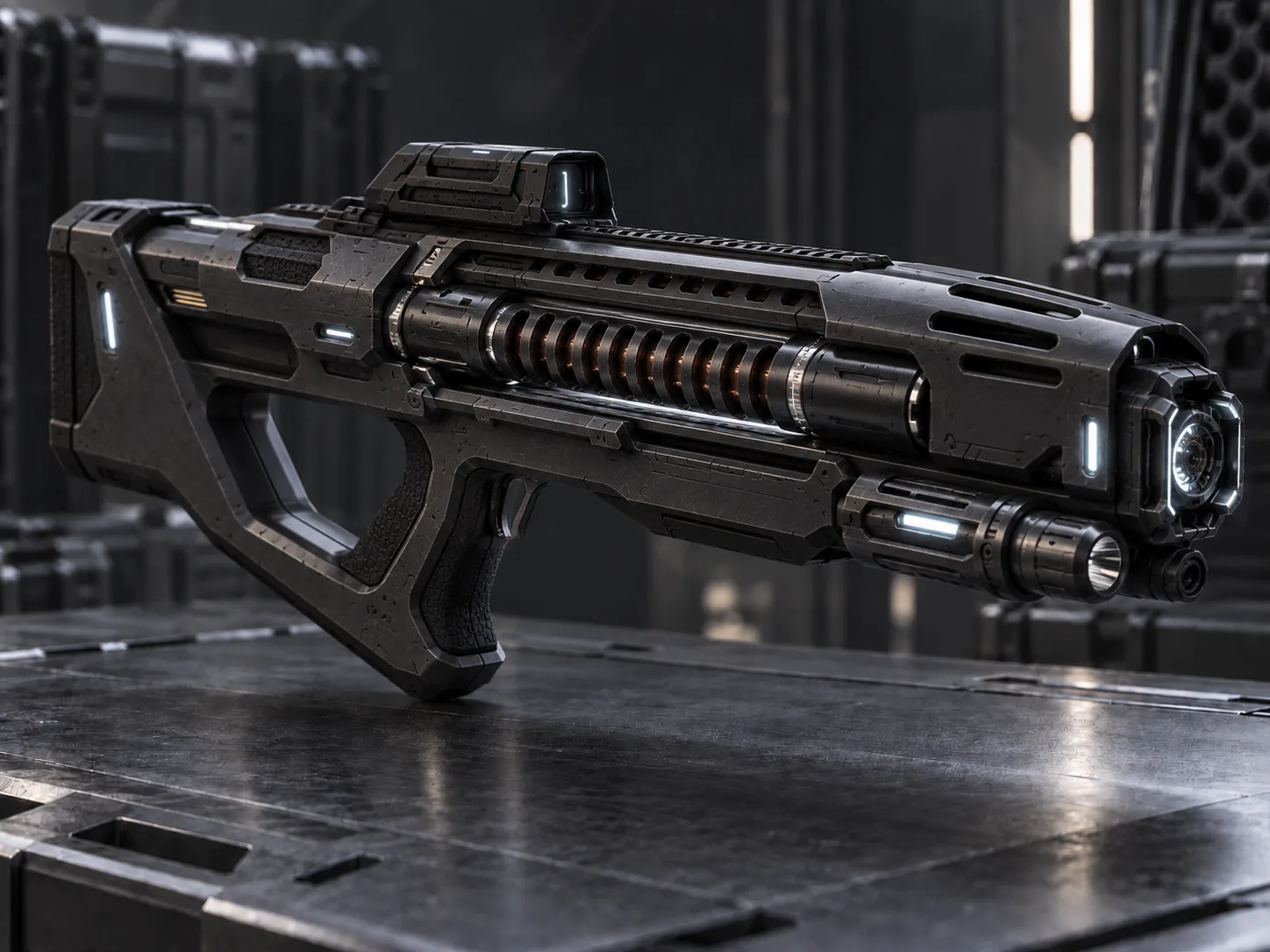
The XMR-12 “Basilisk” is a variable particle pulse carbine held in the Blackwatch arms room as an option. It is drawn for a specific problem — adaptive shielding, a hardened target, a hostile environment, an operation that cannot be traced back to Starfleet — and returned to the rack afterward.
Configuration
- Role: Blackwatch special-operations energy weapon
- Configuration: Compact carbine
- Power source: Unmarked high-density sarium-krellide energy cartridge
- Energy system: Cartridge-fed isolated pulse-capacitor bank
- Emitter: Variable particle pulse emitter
- Operation: Standalone, with no network connection required
Firing Modes
Standard Pulse — General-purpose anti-personnel fire. The default setting and the one an operator will use for nearly everything.
Adaptive Pulse — Continuously shifts discharge characteristics to delay Borg and other adaptive shielding. It buys time; it does not win the argument permanently.
Shield-Disruption Pulse — Optimised against defensive fields rather than against the person behind them.
Penetration Pulse — Concentrated high-density discharge for hardened targets and barriers.
Overcharge Pulse — Maximum-output capacitor dump, for emergency use only. It is a last resort and is treated as one.
Environmental Protection
The Basilisk is built to keep working where a standard phaser degrades.
- Radiation-hardened circuitry
- Shielded capacitor and power regulation
- Resistant to electromagnetic and subspace interference
- Short-pulse architecture for ionised and plasma-rich environments
- Partial resistance to dampening fields
- Automatic emitter recalibration in unstable local fields
Austere Mode
A fallback configuration for when the sophisticated half of the weapon becomes a liability — heavy interference, a compromised environment, or a mission where nothing may be emitting.
Disabled: networking, advanced targeting, adaptive computation, and external sensor feeds.
Retained: manual sights, trigger control, capacitor discharge, the basic pulse emitter, and manual output selection.
In austere mode the Basilisk is a plain carbine that still fires. That is the entire point of the setting.
Targeting
- Passive optical sight
- Local range estimation
- Environmental compensation
- Shield-response analysis
- Passive anomaly detection for possible cloaked targets
Deniability
The weapon carries nothing that identifies where it came from. It has no Starfleet markings, no Federation serial numbers, no LCARS systems, no Starfleet-pattern power cells, no Federation firmware, and none of the standard components a Starfleet phaser would be built from.
Components are deliberately sourced and patterned to obscure origin. Recovered from a body or a wreck, the Basilisk is an unusual weapon of no clear manufacture — which is exactly what it is meant to be.
Design Philosophy
Graceful degradation. The advanced systems are built to fail individually rather than together. Losing the targeting package, the adaptive computation, or the sensor feed does not stop the weapon firing; it simply becomes a simpler weapon.
Strengths. Adaptability, reliability in hostile environments, anti-shield performance, Borg resistance, and deniability.
Weaknesses. Higher power draw, greater maintenance burden, more emitter heat, a more complex build than anything else in the rack — and the certainty that a sufficiently capable defence will eventually adapt to it anyway.
That last point is understood and accepted. The Basilisk is meant to open a window, not to hold one open.
Last updated 1 week ago by