Blackwatch: XMP-7 "Wraith"
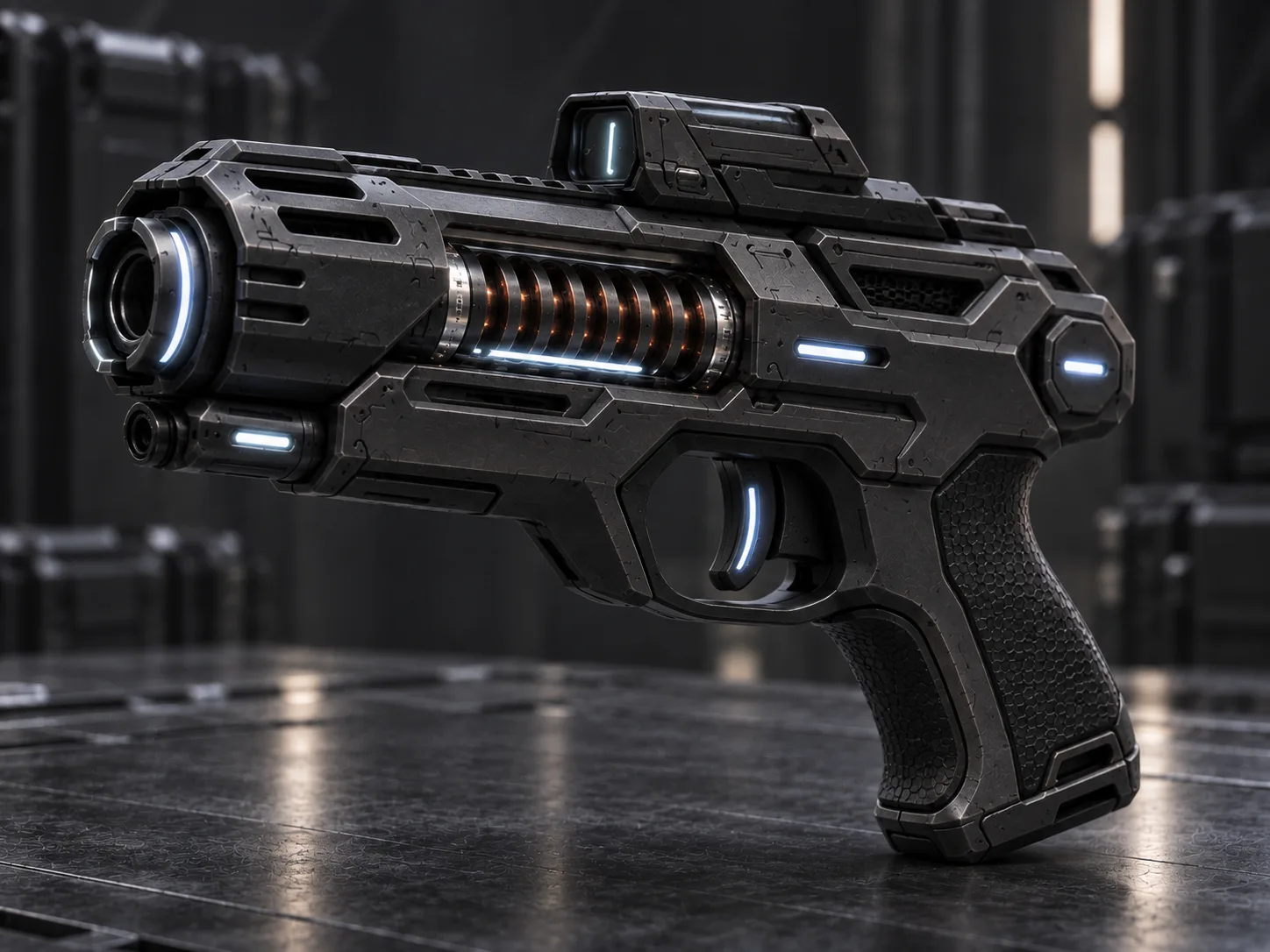
The XMP-7 “Wraith” is a compact variable particle sidearm carried as a secondary weapon — the thing an operator still has when the primary is gone, jammed, or was never an option to begin with. It is small enough to conceal, quiet enough to carry under civilian dress, and built to the same rule as everything else Blackwatch takes off the ship: nothing on it says where it came from.
It shares its design language with the XMR-12 “Basilisk” carbine — the same variable particle emitter concept and the same fallback philosophy — scaled down to a weapon that fits a hip or a coat. Where the Basilisk is drawn for a specific problem, the Wraith is simply worn.
Configuration
- Role: Blackwatch secondary, concealed and close-quarters weapon
- Configuration: Compact energy sidearm
- Power source: Compact unmarked sarium-krellide energy cell
- Energy system: Isolated micro-capacitor bank
- Emitter: Short-cycle variable particle emitter
- Operation: Fully standalone, with no network connection required
Firing Modes
Standard Pulse — General anti-personnel use, and the setting the weapon spends nearly all its life on.
Adaptive Pulse — Limited frequency and phase cycling against adaptive defences. Narrower in scope than the carbine’s equivalent; it delays a problem rather than solving one.
Disruption Pulse — A stronger short-range effect against shields and equipment, useful for opening a door or dropping a field at arm’s length.
Overcharge Pulse — Maximum-output emergency shot. It empties the reserve and heats the emitter, and is treated accordingly.
Environmental Safeguards
- Radiation-hardened electronics
- Shielded power regulation
- Resistance to electromagnetic and subspace interference
- Short-pulse architecture for ionised and plasma-rich environments
- Partial dampening resistance
- Precharged capacitor reserve, allowing limited fire while under suppression
- Automatic fallback to simplified operation if the advanced systems fail
Austere Mode
The same fallback the carbine carries, and on the Wraith it happens by itself if anything upstream fails.
Disabled: network functions, advanced targeting, adaptive computation, and external sensor feeds.
Retained: manual sights, trigger, capacitor, basic emitter, and manual output selection.
Targeting
- Passive optical sight
- Basic range estimation
- Limited environmental compensation
- Simple shield-response sensing
Deniability
As with the rest of the kit, the Wraith carries no Starfleet markings, no Federation serials, no LCARS systems, no Starfleet-pattern firmware, none of the standard Starfleet power-cell architecture, and no standard phaser components.
Concealment makes this matter more here than on the carbine. A sidearm is the weapon most likely to be carried into a place where a Starfleet weapon cannot be, and the most likely to be found on someone.
Design Emphasis
Strengths. Compactness, concealment, reliability, forensic ambiguity, and flexibility at close range.
Weaknesses. Shorter range, a smaller capacitor reserve, reduced adaptive capability, and faster heat buildup under repeated high-output fire.
None of that is a flaw in the design so much as the cost of the size. The Wraith is not meant to win a firefight — it is meant to be there when the weapon that was supposed to win it is not.
Last updated 1 week ago