

Blackwatch: Red MEC Breaching Charge
Palm-sized latinum-nitrium breaching charge carried as standard by Blackwatch operators.
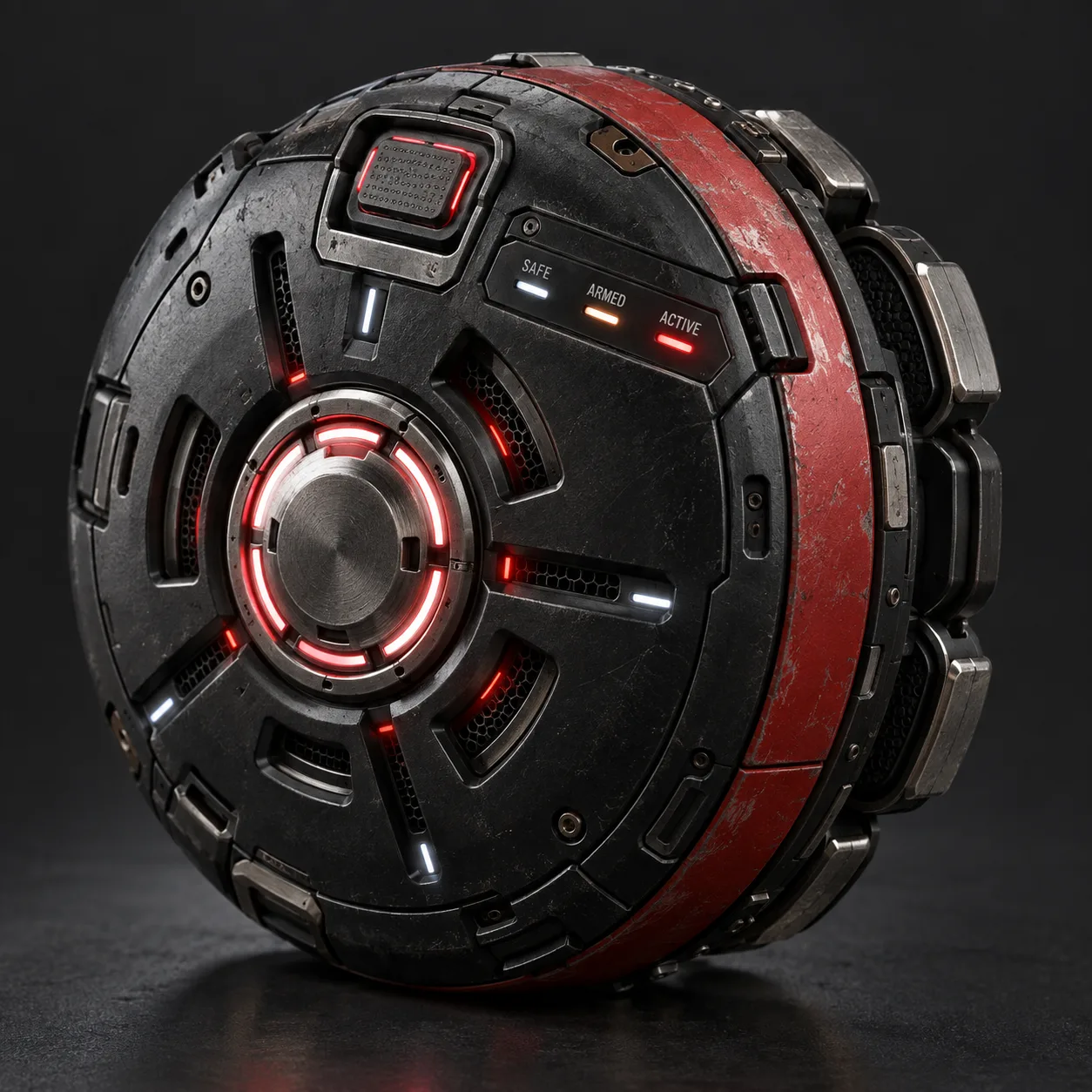
The Red MEC is a compact, palm-sized breaching device carried as standard by Blackwatch operators. It is not an explosive. It is placed against a door, hatch or bulkhead and made to eat it.
Description
The body is a low-profile circular puck roughly 10 centimetres across and 3 centimetres thick, closer in shape to a small magnetic mine or an engineering puck than to a conventional charge, which lets it sit flat against a surface.
The casing is matte black and dark metallic composite, with a reinforced red identification band around the circumference marking it as a breaching MEC. The face is slightly convex, with a recessed central emitter plate surrounded by narrow segmented vents and status indicators.
The rear carries a conformal magnetic and molecular-adhesion mounting ring that locks the charge against duranium, tritanium and other common structural materials. Once placed, the mount compensates automatically for minor curvature or irregularity to hold full contact.
The latinum-nitrium ampule sits at the centre of the unit behind the emitter plate. It is sealed until activation and is not accessible in the field.
Controls
Deliberately simple. A recessed arming pad sits along the upper edge of the casing beside a status strip reading SAFE, ARMED and ACTIVE. Once armed, the device scans the surface to confirm contact with a valid structural material before it will allow activation.
Effect
On activation the emitter plate glows a dull red-white as the amalgamation is atomised directly into the target surface. There is no detonation flash. The device stays where it is while the treated material begins to shimmer, fracture and lose cohesion around it.
In the final stage of the reaction the casing and internal components are consumed along with the remaining active material. Nothing recoverable is left behind — no latinum, no reagent, no intact device.
Carriage
The Red MEC fits a rigid belt pouch or clips into a purpose-built retention bracket on Blackwatch field gear. Two units sit side by side in roughly the space of a standard utility pouch.
Technical Specifications
- Designation: Red MEC — latinum-nitrium amalgamation breaching charge
- Type: Placed structural breaching device
- Primary role: Controlled breach of internal duranium and tritanium barriers
- Form factor: Low-profile circular puck
- Diameter: Approximately 10 cm
- Thickness: Approximately 3 cm
- Carry weight: Approximately 500–650 g
- Standard issue: 2 per Blackwatch operator
- Specialist load: 4–6 per engineering or breaching specialist
- Mounting: Conformal magnetic and molecular-adhesion ring, rated for most Federation-standard structural alloys including mildly curved or irregular surfaces
- Activation: Manual placement and arming, with automatic material verification before initiation
Operating Effect
The charge projects a controlled latinum-nitrium amalgamation into the outer structure of the target. The active nitrium compound propagates through local alloy boundaries and produces rapid material embrittlement rather than explosive fracture.
Linked Placement
Red MECs can be slaved together. When two or more are set on the same barrier, each charge advertises itself over a very low-power near-field handshake and the group agrees a single initiation point, so the whole set fires as one rather than in a ragged sequence.
This matters because the embrittlement front spreads through the alloy from each charge. Fired together, those fronts run into one another and the weakened sections merge into a single aperture. Fired seconds apart, the first charge has already begun degrading the material the second one is trying to read, and the result is two ragged patches with sound structure between them.
- Link range: approximately 2 metres, and only across contiguous structural material — charges on separate panels or on opposite sides of a frame will not pair
- Group size: up to four charges. Beyond that the additional units add little, and the limits below still apply
- Initiation: the last unit armed becomes the initiator; triggering any member of the group fires all of them
- Verification: each charge confirms its own surface contact before joining. A unit that cannot confirm drops out of the group and reverts to independent operation rather than holding the rest up
- Link indication: once the group is agreed, every indicator on the status strip of every linked unit goes solid green. Green across the set is the operator's confirmation that the charges are paired and will fire together; a unit that has dropped out stays on its normal armed indication and is visibly the odd one out
- Silent mode: the handshake is a deliberate emission, weak and short-ranged but not nothing. Against sensitive sensors it can be disabled and the charges paired by hand before placement, at the cost of the automatic verification and the green confirmation that goes with it
For a wide door, a double hatch, or a reinforced section with a heavy locking spine, the usual practice is two charges either side of the structural centre line, linked. Linking does not raise the ceiling on what the device can defeat — it makes the opening a usable shape.
Performance
Nominal breach time: approximately 3–8 seconds after activation, depending on composition, reinforcement and thickness.
Nominal effective thickness:
- Standard duranium barrier: up to approximately 15 cm
- Duranium-tritanium composite: approximately 8–10 cm
- Reinforced security doors: variable; multiple MECs may be required
- Heavy blast doors and armoured structural members: generally outside normal operating limits
- Exterior starship hull plating: not rated for breach
Effective area: compromises a localised section rather than destroying the whole barrier. On standard doors the weakened section is usually enough to create an entry aperture or let the remaining structure be displaced mechanically.
Thermal output: low compared with conventional breaching explosives. There is localised heating in the treated material, but the device is not intended to burn or melt through.
Blast and overpressure: minimal. There is no high-explosive blast wave.
Fragmentation: minimal. Treated material fails as coarse granular particulate and fractured alloy rather than high-velocity fragments.
Residual material: none. The charge consumes its reactive material and its own casing in the final stage.
Operational Limitations
- Optimised for internal structural barriers, not heavy armour.
- Effectiveness drops sharply against layered structures with void spaces, ablative materials, structural forcefields, or alloys engineered to resist grain-boundary propagation.
- Requires direct physical contact. It cannot be thrown, projected, or used across an air gap.
- Material composition matters. The reaction is tuned for duranium and tritanium-based alloys; performance against unfamiliar alien alloys may be reduced, unpredictable or nonexistent until the material is analysed.
- The reaction is localised. A badly placed charge may weaken the target without opening it. On doors and hatches, placement near the centre or the primary locking section is preferred.
- Active structural integrity fields can substantially reduce effectiveness by holding cohesion after the underlying material begins to fail.
- Not designed to defeat hull armour, reactor containment, dedicated blast doors or hardened vault structures with a single charge.
- Multiple charges can be used against heavier barriers, and should be linked when they are, but the effect does not scale indefinitely. Past a certain thickness or reinforcement, an engineering cutter or a dedicated breaching system is required.
- Safer than an explosive charge, but the treated section can still collapse abruptly. Personnel stay clear of the breach face during activation.
The Red MEC is a breaching tool, not a weapon. Its narrow reaction zone, contact requirement and material-specific chemistry make it poorly suited to use against personnel or in the open.
Last updated 1 month ago by