Serrath-type Warbird
Tal Shiar counter-infiltration warbird variant operating on this border.
In 2370 the Tal Shiar is completing a warbird variant that is not built to fight the Federation's ships. It is built to find the things the Federation sends when it does not send ships.
Starfleet has no Romulan designation for it. The name in use aboard the Rubicon, Serrath, is a project word recovered from a cipher fragment, and nobody knows whether it refers to the vessel, the programme, or the man who authorised it.
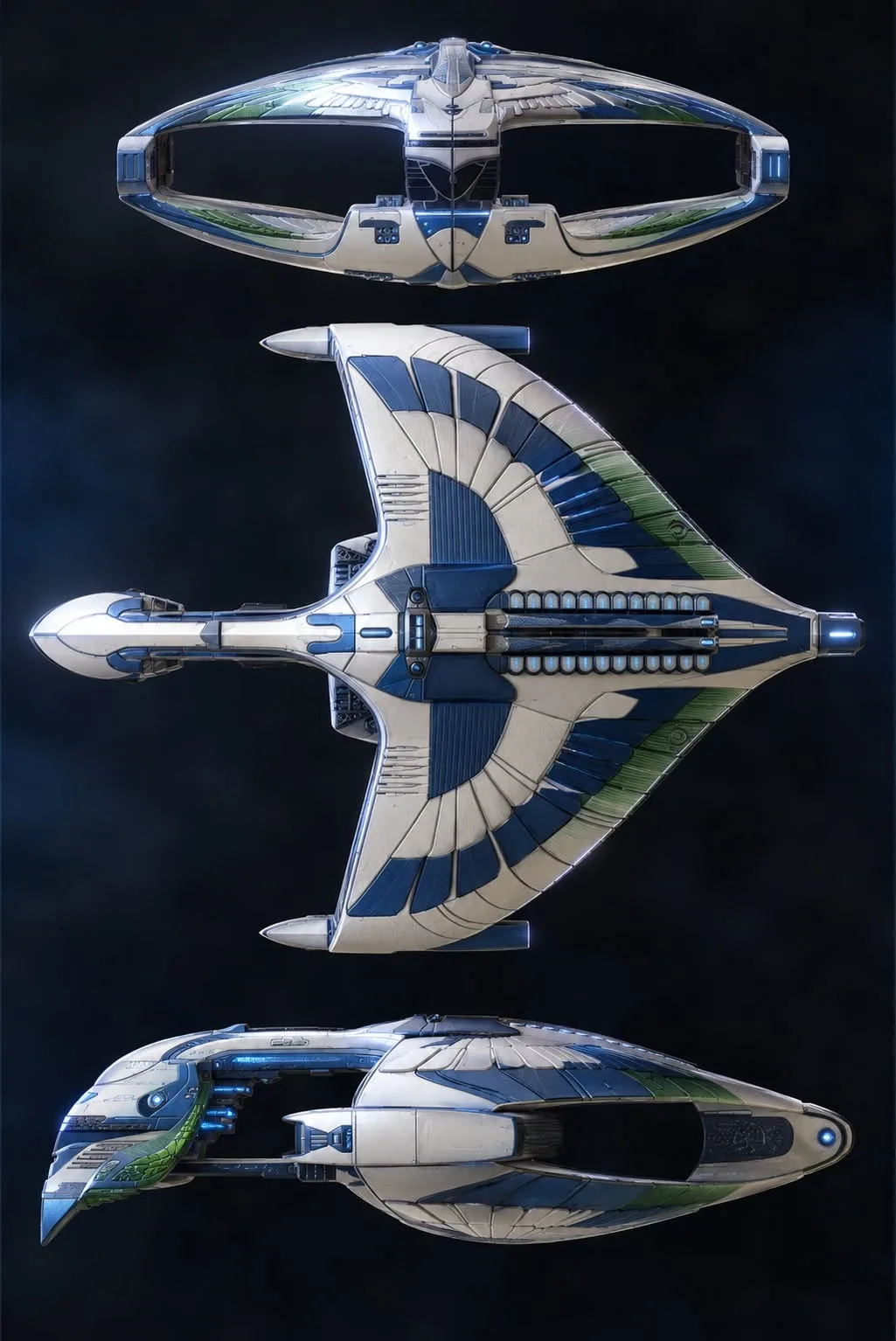
What makes it different
The hull is conventional enough: smaller than a D'deridex, faster, lighter in the broadside, and unremarkable in a line engagement. Everything that matters is inside it.
- A sensor suite tuned to the wrong things. It is not looking for warp signatures or shield harmonics. It is built to pick out the low-emission profiles that covert craft rely on — running-dark auxiliaries, cold-drift approaches, the specific quiet that a Cormorant makes on an insertion run.
- A cloak a generation ahead of the fleet's. Faster to cycle, with a smaller tell on the way in and out, which is what allows it to hold position near a target long enough to watch rather than sweep past.
- Its own infiltration complement. Small craft and the people to fly them, so it does not have to bring a warbird's worth of attention to a landing.
- Tal Shiar crewed throughout. Not an Imperial Fleet vessel with Tal Shiar passengers. There is no Fleet officer aboard to object, and no Fleet chain of command to appeal to.
Known specifications
- Type: warbird variant, counter-infiltration
- Length: approximately 680 m, roughly half a D'deridex
- Crew: assessed at 400–500, well under a standard warbird
- Cruise: warp 6.5 · Maximum sustainable: warp 9.4 · Emergency: warp 9.8
- Armament: lighter than a D'deridex — forward and dorsal disruptor arrays, plasma torpedo launchers fore and aft
- Defences: standard Imperial shielding, reinforced forward; no unusual protection observed
- Auxiliary: bay for four to six small craft, configuration unknown
- Sensors: wide-field passive array, plus an active hunting mode of unknown range
Capabilities and limits
The hunting sweep is the whole ship, and it costs. Running the active array at full power draws more than the cloak can be sustained alongside, which is why the vessel observed in the Zone has been seen to go quiet before it goes looking. It hunts, or it hides. Not both indefinitely.
It is also a prototype. It has been fitted, refitted and re-tuned at the same yard three times in fourteen months, and every one of those returns is a window in which it is not at sea and its crew are not aboard.
In a stand-up fight against a prepared opponent it is not exceptional. The danger is that it does not intend to have one. A ship that can find an insertion before it lands does not need to beat the Rubicon; it only needs to make the Rubicon's methods stop working, and there is no version of this border where Starfleet can replace those methods quickly.
What the Federation knows
Very little of this came from one place. The alloy came off a landing zone, the designation out of a cipher, the weapon signature off a wreck, and the hull itself from a week spent lying on a moon above the slips. Each fragment was deniable on its own. Together they are a programme with a completion date.
Nothing on this page has been acknowledged by the Romulan Star Empire, and no part of it exists in any record the Federation would admit to holding.
Writing it
The Serrath works best as pressure rather than as a monster. It is most frightening in the missions where it is not present — when a team is compromised for no visible reason, when a route that has always been safe suddenly is not, when the quiet stops meaning what it used to mean.
When it finally appears, it should not feel like a duel. It should feel like being seen.
Last updated 4 days ago by