
Romulans and the Federation
Treaties, the Zone's rules, famous incidents and how the two powers deal with each other in 2393.
1. Overview
The Federation and the Romulan Star Empire have never been friends, and only once, briefly, allies. For most of the two centuries since they first met they have dealt with each other across the Romulan Neutral Zone, under a peace that began as a buffer after a war and has been restated, tested and stretched ever since. The relationship is old enough to have habits. Both sides know the rules, both sides test them, and both sides take care to be able to say they kept them.
This article covers the agreements between the two powers, the best-known incidents in their history, and how they deal with each other in 2393. For the full story of the Empire see History of the Romulan Star Empire, and for dates see Timeline. For the line as Starfleet patrols it today, see The Neutral Zone (2393) and Starbase 234 and the Patrol Region.
2. The Peace of 2160
The first agreement between Earth and the Empire ended the Earth-Romulan War in 2160. It was arranged entirely by subspace radio. The two sides had fought for four years without seeing each other, and they made peace the same way. Its central term was the Romulan Neutral Zone, a buffer between their territories that neither side may enter without it being taken as an act of war.
The Zone was a solution to a problem both sides understood. Neither could defeat the other outright at an acceptable cost, and neither trusted the other to keep a simple border. A strip of empty space that both agreed to leave alone gave each side warning time, and gave both a clear test of intent: a ship inside the Zone had chosen to be there. That logic still underlies everything else in this article. The Federation inherited the peace when it was founded the following year.
3. The Treaty of Algeron (2311)
In 2311 the two powers clashed in the Tomed Incident, and in the same year they signed the Treaty of Algeron. The Federation has never published a full public account of Tomed, and this article does not attempt one.
The treaty restated the Neutral Zone and its rules. Its best-known term is the one the Federation gave up: under Algeron, the Federation agreed not to develop or use cloaking technology. The Empire kept its cloak; the Federation agreed to go without. Why the Federation accepted that term has been argued over ever since. The usual answer is that peace on the Zone was worth more to the Federation than a weapon it did not yet have, and that the Federation’s strength lay in what it could see rather than what it could hide. Whatever the reason, the ban has held as the Federation’s formal position for more than eighty years, and it is still in force in 2393.
After Algeron the Empire withdrew from contact with the Federation for fifty-three years. The treaty was the last agreement the two powers made before that long silence, and it remains the legal basis of the border today.
Provisions most often cited
| Provision | In brief | Notes |
|---|---|---|
| The Neutral Zone | The Zone is restated as a buffer between the two powers | Its origin is the peace of 2160 |
| Entry into the Zone | Neither side enters the Zone without it being treated as a breach, and possibly an act of war | The rule both sides test most often |
| Cloaking | The Federation will not develop or use cloaking technology | Breached in secret by the USS Pegasus, 2358; exception for the USS Defiant, 2371 |
4. The Rules of the Zone in Practice
A treaty sets the rules. Two centuries of practice decide what they mean. Over that time a body of accepted custom has grown up around the Zone, partly from incidents and partly from what each side has learned the other will tolerate. Neither side has written all of it down, and neither would sign it if asked. Starfleet officers posted to the line learn it as working practice.
Entry. A ship that enters the Zone has made a choice, and the other side is entitled to treat it as one. In practice both sides read intent as well as position. A ship that strays and leaves at once is handled differently from one that stays.
Notice. Where one side has to approach or enter the Zone for a reason it means to defend, such as a rescue, it is expected to tell the other side first. Notice does not make an entry lawful, but it makes it explicable. An entry without notice is treated as hostile until shown otherwise.
Distress. A ship in distress inside the Zone or near it may be helped. The helper is expected to give notice, do only what the rescue requires, and leave. A distress call from the Zone is also, on this border, the oldest trap there is, and Starfleet crews are trained to treat every one as both a duty and a risk.
Shadowing. Ships of each side routinely follow ships of the other along their own side of the line. This is accepted. It is a way of saying “we see you” without saying anything.
Weapons. No rule of the Zone is more important than this one: the side that fires first owns the consequences. Every Starfleet commander on the line works under the standing guidance never to be that side.
5. Famous Incidents
The history of the two powers is in large part a history of incidents, each of which taught both sides something about the other. The following are the best known.
The outposts of 2266 and 2364
Twice the Empire has announced itself by destroying outposts. In 2266 a Romulan bird-of-prey crossed the Zone and destroyed several Earth outposts before the USS Enterprise destroyed it. That was the first time the Federation saw a Romulan. In 2364, after fifty-three years without contact, outposts on both sides of the Zone were found destroyed. Both sides denied responsibility. A Romulan warbird then met the USS Enterprise-D at the Zone, and the Empire made clear that it was back. Whoever destroyed the outposts of 2364, both sides read the event as a message, and the Federation answered by watching the Zone with an attention it had not paid in decades.
The Pegasus
The Pegasus affair is the incident the Federation would most like forgotten and the one Romulans are most likely to raise. In 2358 the USS Pegasus was secretly testing a cloaking device that could also pass through solid matter. The test broke the Treaty of Algeron. The ship was lost, and the secret with it, until 2370, when the wreck was found inside an asteroid near the Zone. A Romulan warbird was searching for it at the same time. The affair ended when the USS Enterprise-D, having used the device to escape the asteroid, decloaked in front of the Romulan ship, and the breach was admitted openly. The officer responsible was arrested. To the Federation this showed that it would hold itself to the treaty even at a cost. To many Romulans it showed that the Federation had broken the treaty and was caught.
The Defiant’s cloak
In 2371 the Empire lent the Federation a cloaking device for the USS Defiant, under strict terms. The device was to be used only in the Gamma Quadrant, against the Dominion, and the Empire received intelligence in return. It was the first and only lawful exception to the Algeron ban. The Federation regards it as an arrangement between two governments for a particular purpose, not a change to the treaty.
The Dominion War alliance
The Empire signed a non-aggression pact with the Dominion in 2373 and stayed out of the war. In 2374 Senator Vreenak was killed on his way home from a meeting with Federation officials, the evidence pointed to the Dominion, and the Empire entered the war on the Federation’s side. Romulan and Starfleet ships fought together from then until the Dominion surrendered in 2375. The alliance was real, and so were its strains. In 2375 the Empire placed plasma torpedo launchers on Derna, a moon in the Bajoran system, and took them down only after Bajor and the Federation refused to accept them. The same year Senator Cretak, the Empire’s senior representative at Deep Space Nine, was removed from office after the Tal Shiar chairman, Koval, accused her of treason. The alliance ended with the war.
The joint recovery of 2377
The one piece of cooperation to outlast the war was the clearing of its battlefields. In 2377 the Federation, the Klingon Empire and the Romulan Star Empire set up a joint recovery initiative, each contributing twelve ships, led by the USS Viola. For most of a decade its crews dismantled derelicts, recovered material and returned the dead to their homeworlds, Romulan dead included. It is remembered in Starfleet as proof that the two powers can work side by side when the task is plain and the purpose is decent.
The Bassen Rift
In 2379 Shinzon killed the Romulan Senate, made himself Praetor and offered the Federation peace while preparing to attack Earth. In the Bassen Rift, two Romulan warbirds under Commander Donatra turned against him and fought beside the USS Enterprise-E. Donatra thanked the Federation afterwards. The moment raised hopes that did not last. Within months the Empire had turned inward. See Government of the Empire.
| Year | Incident | What each side took from it |
|---|---|---|
| 2266 | Earth outposts destroyed; first sight of a Romulan | The Empire had new weapons and a cloak; the Federation would fight |
| 2268 | Romulan cloaking device taken by the USS Enterprise | A grievance the Empire still remembers |
| 2311 | The Tomed Incident; the Treaty of Algeron | The rules of the modern border; the cloaking ban |
| 2364 | Outposts on both sides destroyed; both deny it | The Empire was back |
| 2366 | Romulan scout crashes on Galorndon Core | A standoff ended without a shot |
| 2368 | Plot to invade Vulcan exposed | The Empire would use Unification as cover |
| 2370 | The Pegasus recovered | The Federation broke the treaty, then admitted it |
| 2371 | Cloaking device lent for the Defiant | Exceptions were possible, for a price |
| 2374 to 2375 | Alliance against the Dominion | Allies of necessity, not of trust |
| 2377 | Joint recovery initiative | Plain work could be shared |
| 2379 | The Bassen Rift | Hope that faded within months |
| 2391 to 2392 | T’Met; relief; admission to the Federation | An affront to the Empire that has not been answered |
The Ragnarok years (2390 to 2392)
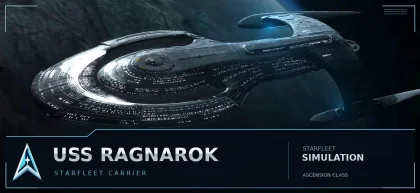
The sharpest recent incidents between the two powers involve one ship, the carrier USS Ragnarok. In 2390 talks aboard her with the Romulan ambassador V’rel, about raiders striking shipping where the Federation, Klingon and Romulan borders meet, ended with the Romulans warning that any crossing of the border would be treated as an act of war. That same year Starfleet carried out a classified operation against a pirate base on Ad Pontes, inside Romulan space; the Empire never protested it in public, but a Romulan commander later called it a violation of the Neutral Zone. In 2391, at T’Met, Imperial warbirds faced the Ragnarok over a Reman world, the Empire’s envoy died in a bombing at the talks, and the two sides’ fighters fought for more than a day before the Empire withdrew. Each of these is read differently on either side of the Zone. See The USS Ragnarok and the Romulans.
6. The Cloaking Question
No subject is more sensitive between the two powers. The cloak is the centre of Romulan military thinking, and the Federation’s promise not to have one is, in Romulan eyes, the most valuable thing Algeron gave them. Any sign that Starfleet is working on cloaking technology is treated by the Empire as a breach of the treaty and a threat in itself. The Pegasus affair is the proof Romulans cite that such work has happened before.
The Federation’s position in 2393 is unchanged: it does not develop or use cloaking technology, outside the one arrangement the Empire itself agreed to in 2371. What became of that arrangement after the war is not on the public record. Starfleet officers on the Zone are reminded that the Empire watches for any departure from the ban with great care, and that its accusations do not need to be true to cause a crisis.
7. Relations in 2393
Relations between the two powers in 2393 are formal, cold and correct. There is no war and no alliance. The Empire has come back to its border, and both sides are careful to say that nothing is happening there.
Channels
Contact at the level of governments runs through envoys meeting by agreement, usually at sites chosen for being nobody’s ground. Meetings are rare and announced afterwards, if at all. Below that level, the main working link is the standing subspace channel that each side keeps open for notices under the Treaty of Algeron. Starfleet officers call it the Algeron channel. It carries notices of rescues near the Zone, reports of ships in distress, and formal protests. It is answered promptly and politely, and it almost never carries anything that matters in plain words.
At the line itself, the working channel is the hail. Commanders of ships that meet on either side of the Zone speak to each other directly, often at length and always with care. Many of the important conversations between the two powers in any given year happen this way, between two ship commanders who know their words will be read by their governments. On the Federation side, the regional authority for this stretch of the Zone is Starbase 234. On the Romulan side, it is Chaltok Sector Command. See The Romulan Side of the Zone.
Protocols at the line
Starfleet guidance for ships on the Zone in 2393 follows the practice described in section 4, with some points stressed more than others. Ships keep to their own side. Any approach to the Zone for a stated purpose is notified first through the Algeron channel. Romulan ships seen on their own side are logged and, if they hold position, reported, but they are not challenged, since they are where they have every right to be. Cloaked contacts, when they are detected, are reported and not pursued across the line. A hail from a Romulan commander is always answered, and the answer is always recorded.
What counts as a provocation
Romulan provocation on this border is rarely a shot fired. It is meant to test, not to fight, and it is built so that it can be denied. Starfleet’s own assessments list the forms most often seen:
Presence. A warbird that sits on its own side of the line for a week, close to a Federation station or patrol route, saying nothing. It is lawful. It is also a message.
Drift. A sensor buoy that “malfunctions” and drifts across the line, close enough to read what it was never meant to read, and recoverable with an apology.
Distress. A distress call from inside the Zone, real or false, made to see who answers, how fast and with what.
Shadowing. A cloaked ship that lets itself be detected for a moment, to show that it was there all along.
The purpose of all of these is to learn how the Federation thinks: how its ships respond, how fast its commanders decide, and what they will do when the rules are unclear. The best response, in Starfleet’s view, is the one that teaches the Empire the least.
The Empire has its own list. Romulan protests through the Algeron channel most often concern Federation sensor activity near the line, the movement of Federation ships close to the Zone, any sign of work on cloaking technology, Federation dealings with T’Met, and Federation support for the Vulcan reunification effort.
The open questions
Two questions sharpen relations in 2393 beyond the ordinary. The first is T’Met. Its Remans broke away from the Empire, suffered what is believed to have been a biogenic attack in 2391, received Federation relief, with the USS Ragnarok working to settle the region, and joined the Federation in 2392. To most Romulans this is the Federation taking the Empire’s own subjects. See T'Met, The USS Ragnarok and the Romulans and The Remans. The second is Unification. Starfleet, after years of distance, now regards the Vulcan reunification effort as wise and quietly backs it. The Empire reads this as interference in its internal affairs, and instability on the border is the greatest threat the effort faces. See Dissidents, Splinters and Unification.
8. The Klingon Angle
The Federation does not face the Empire alone on this border, and its ally is not easy to manage. The Klingons have never forgiven Narendra III, where Romulan warbirds attacked a Klingon outpost in 2344 and the USS Enterprise-C died defending it, nor Khitomer two years later. A Klingon commander near the Zone shares the Federation’s adversary but not its methods. Where Starfleet sees an incident to be defused, a Klingon captain may see an insult to be answered. The Empire knows this, and has more than once in its history tried to divide the two allies. Managing the Klingons is part of managing the Romulans. See The Klingon Empire.
9. See Also
The Romulan Star Empire · History of the Romulan Star Empire · Timeline · Government of the Empire · The Romulan Side of the Zone · The Neutral Zone (2393) · Starbase 234 and the Patrol Region · The Klingon Empire
Last updated 3 days ago by