T'Met
The Reman republic beyond the Romulan border: breakaway, the 2391 attacks, and Federation membership.
1. Overview
T’Met is a Reman-settled star system just outside the border of the Romulan Star Empire, and the only Reman world that does not answer to the Empire. Its people, Remans whose families were sent there to work, slipped out of Imperial rule during the Silence and in 2390 declared the T’Met Republic, led by an office they call the Caliph. The Empire never accepted the break. It tried for years to talk T’Met back into the Empire, and in 2391 the people of T’Met were struck by biogenic weapons that killed tens of thousands of them. The Federation holds that the Empire was responsible. The Empire denies it.
T’Met asked the Federation for help, and Starfleet answered with a relief effort that lasted many months. In 2392 T’Met was admitted to the Federation. In 2393 it is a member world still rebuilding from the attacks, governed by Remans for the first time in its history, and regarded by the Empire as a stolen province. Few places in this part of space say more about why the border has grown harder every year.
This article draws on Federation relief records, on what the Republic has told the Federation since 2391, and on the Empire’s few public statements. For the Remans as a people see The Remans.
2. The System
T’Met is a small system around a dim orange star. It has one inhabited world, the fourth planet, which the Remans call by the same name as the system. The planet is cold and dry, with long nights and a weak, reddish daylight. It would be a hard world for most peoples. For Remans, whose eyes are made for darkness and who suffer in bright light, its dim sun is one of its few kindnesses, and Reman settlers have long described it as the first world they could stand on without pain.
The planet’s wealth lies underground. Its crust holds mineral deposits, among them dilithium, that drew Imperial interest long before any Reman lived there. Most of the population lives in and around old mine workings, in settlements cut into rock and built partly underground. The largest of these, Sharlos, grew around the main shafts and serves as the Republic’s capital. The northern half of the planet is a cool, dark desert, thinly settled.
The system’s other bodies are barren. A few have been mined in the past, and some old Imperial workings remain on them, unused since the Romulan overseers left.
3. How T’Met Came to Be Settled
T’Met began as an Imperial mining concession. The Empire brought Reman workers to it as it brought them to its other labour colonies: by assignment, with no choice and no expectation of leaving. The date of the first Reman settlement is not known outside the Empire. The Remans of T’Met count several generations on the planet, and their oldest family lines on T’Met go back well before the Dominion War.
For most of that time T’Met was run as every Reman colony was run. Romulan overseers set the work and the quotas, a small Imperial garrison kept order, and the Remans had no say in anything. The colony’s position outside the main body of the Empire mattered little while the Empire was strong and its ships came and went on schedule.
That changed during the Silence, the years from 2379 to 2382 when the Empire had no Senate and rival houses and governors ran their own provinces (see History of the Romulan Star Empire). After Shinzon’s coup, Reman colonies across the Empire came under close watch, but T’Met lay at the edge of the Empire and at the end of a long supply line. According to the Remans of T’Met, the overseers and the garrison were withdrawn during the Silence, as the houses and governors pulled their ships and people back to hold what they could nearer home. The Remans were left where they were. No one came to replace the overseers, and the Remans of T’Met began to run the colony themselves, because no one else was running it. The Empire’s own account of these years has never been published.
4. The T’Met Republic and the Caliph
When the Restored Senate first sat in 2382 and the Empire began to look outward again, it found that T’Met had been governing itself for some time. In 2390 the Remans of T’Met formally declared themselves an independent state, the T’Met Republic. The Empire did not recognise the declaration, and in Romulan law T’Met has never stopped being an Imperial possession and its people have never stopped being subjects of the Empire under protection.
The Republic is led by the Caliph, a single head of state who speaks for T’Met abroad and holds final authority at home. How the Caliph is chosen, how long the office is held, and what checks there are on it are matters the Republic has not set out in detail to outsiders. Federation records refer to the office rather than the person, and this reference does the same. What is clear is that the Caliph commands deep loyalty among the Remans of T’Met, and that the office was central to holding the Republic together through the years of Imperial pressure and through the attacks of 2391.
Below the Caliph, the Republic is governed through councils drawn from the settlements and the old mine crews, which in the Reman way remain the strongest bonds most people on T’Met have. The Republic’s first public statements spoke of showing that Remans are more than servants of the Romulan Empire, and that idea remains at the heart of how it presents itself.
5. The Empire’s Attempts to Take It Back
For several years the Empire tried to bring T’Met back by means short of force, or at least short of open force. As far as the Federation knows, these included:
Envoys and offers. Imperial envoys came to T’Met more than once with offers of a return to Imperial rule on better terms than before: a lighter quota, a degree of local management, a promise that no one would be punished for the break. The Republic refused each of them.
Pressure on trade. Shipping to and from T’Met was discouraged, and traders who dealt with the Republic found their business inside the Empire harder to carry on. T’Met’s isolation grew, and with it the hardship of its people.
Claims in law. The Empire made plain to every power that would listen that it regarded T’Met as an Imperial possession, that its people were Imperial subjects, and that any dealings with the so-called Republic were dealings with rebels.
Watching. The Remans of T’Met believe the Tal Shiar had people among them throughout these years. That has never been confirmed. The Tal Shiar acknowledges no operations of any kind (see The Tal Shiar).
Force. After the Republic’s declaration in 2390 the Empire went further. It cut T’Met off from the supply lines of its neighbours, set up blockades, and landed small groups of troops that took several towns and one city before the Republic’s security forces drove them out.
None of it worked. By the end of the 2380s, under Praetor Ardhal tr’Vesuin, whose praetorship sent the patrols back to the Neutral Zone, the Empire’s patience with T’Met was widely understood to be running out.
6. The Biogenic Attacks of 2391
In 2391, days after the Imperial landing parties had been driven off, the people of Fa’ran, T’Met’s third largest city, began to die of a disease that killed faster and more surely than anything the Republic’s healers had seen. It killed the entire city: almost seventy thousand people, buried afterward in mass graves around it. A Romulan commander later spoke of hundreds of thousands; the Republic’s own figure for Fa’ran is the one given here.
6.1 What the Federation found
Federation medical teams who reached T’Met during the outbreak concluded that the disease was not natural. The agent behind it showed signs of deliberate design, and the way it had been spread pointed to its being released rather than caught. It had been put down as a liquid that evaporated onto surfaces, starting in the city’s largest market, most likely from small devices that could be carried in by hand. Starfleet Medical’s findings were that T’Met had been attacked with biogenic weapons, which the Federation, and every civilised power, regards as among the gravest of crimes.
The Federation’s position is that the Romulan Star Empire was responsible. That position rests on the nature of the agent, on the lack of any other power with a motive, and on further evidence that has not been made public in full.
6.2 What the Empire says
The Empire denies any part in the deaths. Its public statements have described the outbreak as a tragedy among a population living in poor conditions after it abandoned Imperial care, and have rejected the Federation’s findings as invented to justify interference in Imperial affairs. The Empire has offered no evidence for its account, and it has not allowed any inquiry. As with much that happens on this border, the matter is not going to be settled by either side admitting anything.
7. The Federation Relief Effort
During the outbreak the Caliph asked the Federation for help. It was the first time the Republic had formally asked an outside power for anything, and it was a decision taken against old Reman distrust of every outsider. Starfleet answered.
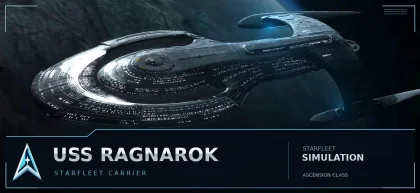
The Republic’s Senate debated for a week before the Caliph signed the law that allowed an appeal to an outside power. Starfleet called its answer a mission of mercy, and the USS Ragnarok was sent within forty-eight hours. The relief effort brought medical teams, supplies and engineers to T’Met. The first task was the disease itself: treating the sick, isolating the agent, and protecting those not yet infected. The second was the living: shelter, food and clean water for settlements that had lost a large part of their people, and help for those left to bury them. The third, once the worst was over, was rebuilding.
The USS Ragnarok took a leading part in this work. Its crew worked on the ground alongside the Remans through the worst of the outbreak and its aftermath, and the ship stayed in the region for some time afterward, working to settle it, helping the Republic to rebuild its settlements and to strengthen its own defences against further attack, before it was called away to other duties. For the ship’s dealings with the Empire, the Remans and T’Met, see The USS Ragnarok and the Romulans. Reman accounts of the relief speak of the Ragnarok often, and with gratitude that the Republic has not been slow to express in public.
The relief was not without its difficulties. Two Imperial warbirds came to T’Met while it was under way, and their commander insisted that its people were still citizens of the Empire. The Uioran Alliance, a trading power to the north, sent a broker with offers of mining rights and membership. At talks in Sharlos a Reman bomber who hated the Romulans killed the Empire’s envoy, Sub-Commander Felaen t’Lehu, who threw herself onto the device, and the Uioran broker with her; Romulan fighters and the Ragnarok’s air wing then fought over the planet for more than a day before the Empire withdrew. And some of the Federation’s people on the ground were intelligence officers in medical uniform, which the Remans learned in time and did not easily forgive. The full story is told in The USS Ragnarok and the Romulans.
The settlement put T’Met under Federation protection in exchange for a small share of its resources, while the Caliph held the Federation’s fuller offer on a one-year stay before a vote of the Republic’s Senate. But the relief held, and it built a trust between T’Met and the Federation that had not existed before.
8. Admission to the Federation (2392)
The year’s stay was overtaken by events. When Borg activity was found just outside Romulan territory and Starbase 185 was lost, T’Met became the Federation’s nearest secure base. The Caliph set his terms: permanent Federation defensive guarantees, and a seat at the table in any campaign against the Borg launched from his system. Starfleet agreed within the hour. Starfleet crews rebuilt T’Met’s planetary defences and trained Reman pilots, and a T’Met task force sailed with Starfleet into the Typhon Expanse, where the Reman cruiser Tal’Vesh was lost. See The USS Ragnarok and the Romulans.
When the Republic’s Senate voted later in 2392, it chose the Federation, and T’Met was admitted. The admission was quick by the Federation’s usual standards, and it was not without debate. Some in the Federation Council argued that admitting a world the Empire claimed as its own would be taken across the Neutral Zone as a hostile act, and that the Federation was taking on a quarrel it could not end. Others argued that a people who had been attacked with biogenic weapons, and who had asked for the Federation’s protection, could not be turned away. The second view carried the vote.
Membership brought T’Met under Federation law and under the Federation’s protection. The Remans of T’Met became Federation citizens. The Republic kept its own government and its Caliph, as member worlds keep their own forms of government. The Empire responded by declaring that it did not recognise the admission and that, in Romulan law, nothing had changed: T’Met remained an Imperial possession and its people Imperial subjects.
| Period | Event |
|---|---|
| Before the Dominion War | Imperial mining concession worked by Reman labour |
| 2379 to 2382 | The Silence; overseers and garrison withdrawn, according to Reman accounts; the Remans run the colony themselves |
| Late 2380s | Imperial envoys, offers, trade pressure and legal claims; all refused |
| 2390 | The T’Met Republic declared, led by the Caliph; the Empire does not recognise it, and answers with blockades and troop landings |
| 2391 | Fa’ran destroyed by a biogenic weapon; almost seventy thousand dead; the Empire denies responsibility |
| 2391 | The Caliph asks the Federation for help; the USS Ragnarok leads the relief; warbird standoff, the Sharlos bombing and the battle over T’Met; the Empire withdraws |
| 2391 | T’Met under Federation protection; one-year stay on the Federation’s offer |
| 2392 | Permanent Federation defensive guarantees; T’Met becomes a Federation staging base against the Borg; the Reman cruiser Tal’Vesh lost |
| 2392 | T’Met admitted to the Federation; the Empire refuses to recognise the admission |
| 2393 | Rebuilding continues; the region less settled than before |
9. T’Met in 2393
Two years after the attacks, T’Met is still rebuilding. Settlements have been repaired or moved, the mines are working again under Reman management, and the Republic has begun to trade openly with Federation worlds. The losses of 2391 are present in every part of life. Few families on T’Met lost no one, and the Republic marks the dead each year.
The Republic’s defences have been strengthened since 2391, with Federation help, and T’Met no longer stands alone. Federation traffic to the system has grown. A small number of Remans from T’Met have begun to travel and study elsewhere in the Federation, and a few have applied to Starfleet Academy.
The Caliph remains at the head of the Republic. The office has spoken in public more often since 2392, almost always to thank the Federation, to remember the dead, or to remind the Empire that T’Met will not return.
10. Why T’Met Unsettles the Border
T’Met lies outside the Empire, and it is not on the Neutral Zone in the strict sense. But it has done more than any single place to harden the border, for several reasons.
It is an affront. To Romulans, Remans are a people meant to serve. A Reman world that walked out of the Empire, survived what was done to it, and found a protector is an insult to the Empire’s idea of its own order. Every year that T’Met stands is another year of that insult.
It is a precedent. If the Remans of one colony can leave, so in principle can others. The Empire’s greatest fear about T’Met, as Federation analysts read it, is not T’Met itself but what Remus might learn from it.
It sits between the powers. T’Met is a Federation member world claimed by the Empire. Any Imperial move toward it would be a move against the Federation. Any Federation presence near it is, in Romulan eyes, a presence in Imperial territory. Neither side can give way on it without giving way on a principle.
It cannot be discussed. The Federation holds that the Empire used biogenic weapons on T’Met. The Empire denies it, and will not hear it said. That leaves a crime at the centre of the two powers’ relations that one side will not stop naming and the other will never admit, and it poisons every other conversation.
The result is that the region around T’Met has grown less stable every year since the breakaway. Starfleet officers on the Neutral Zone should expect the Romulans they meet to have T’Met in mind, whether or not they name it, and should expect any mention of it to be taken badly. For the border itself see The Romulan Side of the Zone and The Neutral Zone (2393). For the effect of all this on the Federation’s quiet hopes for reunification between Romulans and Vulcans see Dissidents, Splinters and Unification.
11. See Also
The Remans · The USS Ragnarok and the Romulans · The Romulan Star Empire · Romulans and the Federation · History of the Romulan Star Empire · Timeline · The Tal Shiar · The Romulan Side of the Zone · Dissidents, Splinters and Unification
Last updated 3 days ago by