
Klingons and Romulans
From 2268 to the 2390 tri-border: Narendra, Khitomer, Duras, the 2380s raids and the feud in 2393.
1. Overview
The Klingon Empire and the Romulan Star Empire have never been at peace in any sense a Klingon would recognise. For most of the last two centuries they have watched each other across a shared frontier, struck at each other when they could, and remembered every blow. The Federation, allied to the Klingons since the Khitomer Accords of 2293 and facing the Romulans across the Neutral Zone since 2160, stands between them on several stretches of space and is never wholly out of their quarrel.
This article sets out the history of that enmity as far as Federation records show it, the Klingon raids into Romulan space in the 2380s and the Romulan answer to them, the tri-border crisis of 2390, how each empire sees the other in 2393, and why Starfleet believes that some Romulan provocations on the Zone are aimed at the Klingons rather than at the Federation. For the Romulan side of the same border see The Romulan Side of the Zone, and for the Romulan account of their own history see History of the Romulan Star Empire. For the Klingon side of the frontier as it stands today see The Klingon Frontier in 2393.
Where this article relies on Starfleet assessment rather than record, it says so.
2. Early Contact and the Exchange of 2268
How and when the two empires first met is not recorded in any source the Federation holds. What is recorded is a moment of cooperation that neither side now likes to remember. In 2268 Starfleet intelligence reported that the Romulans were flying ships of Klingon design, a sign of some exchange of technology between the two powers. The same reports suggested that the Klingon-design ships carried an improved Romulan cloaking device. What the Klingons received in return, how long the exchange lasted and how it ended are not recorded.
Whatever the arrangement was, it did not survive, and neither empire has since shown any wish to discuss it.
3. Khitomer, 2293
When the Federation and the Klingon Empire met at Khitomer in 2293 to make peace, the conference was nearly wrecked by a conspiracy of officers on both sides who wanted war to continue. A Romulan ambassador, Nanclus, was among the conspirators. The plot failed, the conference went ahead, and the Khitomer Accords joined the Federation and the Klingons in the alliance that still holds. For the Klingons the lesson was a lasting one: the Romulans had tried to keep their two greatest rivals at each other’s throats, and had very nearly succeeded. The Romulans, for their part, found that the two powers on their borders would from then on have reason to stand together. See The Alliance with the Federation for the alliance itself.
4. The Years of Isolation: Narendra III and Khitomer
After the Tomed Incident of 2311 the Romulan Star Empire withdrew from contact with the Federation for more than half a century. It did not withdraw from its border with the Klingons. The Klingons felt the weight of Romulan attention in these years far more than the Federation did, and two attacks from this period still shape the way every Klingon thinks of the Romulans.
4.1 Narendra III (2344)
In 2344 Romulan warbirds attacked the Klingon outpost on Narendra III. The USS Enterprise-C answered the outpost’s distress call and was destroyed defending it. A Starfleet crew had died for a Klingon outpost against a Romulan attack, and the Klingons took it as an act of great honour. Many Klingons date the real alliance with the Federation from that day rather than from the treaty signed at Khitomer half a century before. The Klingons have never forgiven the Romulans for Narendra III, and the Romulans know it.
4.2 Khitomer (2346)
Two years later a Romulan attack on the Klingon colony at Khitomer killed thousands. The attack succeeded because a Klingon traitor had given the Romulans the colony’s defence codes. For years afterwards the treachery was laid at the door of an innocent man, and the truth was kept hidden by the High Council because the traitor’s family was too powerful to accuse. The traitor was Ja’rod, father of Duras, of the House of Duras. How that truth was kept, and what it cost, is told in The Great Houses.
Khitomer is the deeper of the two wounds. Narendra III was a battle in which the Klingons, and their new ally, fought and died with honour. Khitomer was a massacre made possible by one of their own.
5. The Return and the Plots (2364 to 2368)
When the Romulans returned to the Federation’s attention in 2364, they also returned to Klingon affairs. Between 2364 and 2368 the Empire made at least two serious attempts to break the Federation-Klingon alliance or to place a friendly faction in power on Qo’noS.
5.1 The Krios plot (2367)
In 2367 Romulan agents captured a Starfleet officer, altered his mind, and sent him back to kill the Klingon governor of Krios during a Federation visit to that world. Had the killing succeeded, the Klingons would have had a Starfleet officer for an assassin and every reason to doubt their ally. The plot was uncovered and the governor lived. Starfleet regards it as the clearest example on record of a Romulan operation aimed at the alliance rather than at either power alone.
5.2 The House of Duras and the civil war (2367 to 2368)
In the same years the Empire reached directly into Klingon politics. The House of Duras was found to have ties to the Romulans, and when its claim to lead the High Council failed, it went to war. In the Klingon civil war of 2367 to 2368 the Romulan Star Empire secretly supplied the House of Duras with ships and weapons. Starfleet ships formed a tachyon detection network along the Klingon and Romulan border, which exposed the Romulan supply convoys. Once they were exposed, the Romulans withdrew, the Duras forces collapsed, and Gowron was confirmed as Chancellor.
The Romulan officer behind much of this, by Federation account, was Commander Sela. For the Klingons the episode confirmed what Khitomer had taught: the Romulans will use any Klingon who can be bought, and a great house can be one of them. Romulan support for the House of Duras is still named by Klingons, along with Narendra III and Khitomer, as one of the three great Romulan offences of living memory.
6. The Dominion War (2374 to 2375)
When the Romulan Star Empire entered the Dominion War in 2374, it came in as an ally of the Federation and the Klingon Empire. For the first time in living memory, Klingon and Romulan ships fought on the same side. It was an alliance of necessity on every side, and every side knew it. Joint Federation-Klingon fleets, such as the Fourteenth Joint Fleet, were a feature of the war. The Romulans fought beside both allies, but Starfleet records describe no comparable joining of Klingon and Romulan forces, and Klingon commanders made little secret of how they felt about their new comrades.
Starfleet officers who served in combined operations remember the arrangement as uneasy but workable. The two empires were co-belligerents rather than friends: they fought the same enemy and kept their distance from each other. Federation officers who served between them say the friction came out mostly in words. An account from the years before the war shows how deep the feeling runs: a Klingon officer in Starfleet once refused to give his own tissue to save a dying Romulan, and the Romulan said he would rather die than accept it. Federation doctors cite it still when they explain why mixed crews of the two peoples are hard to manage. The alliance ended with the war.
7. The Recovery Initiative (2377 to 2386)
The one piece of cooperation to outlast the war was the clearing of its battlefields. In 2377 the Federation, the Klingon Empire and the Romulan Star Empire each gave twelve ships to a joint recovery initiative, led by the USS Viola. For most of a decade its crews worked the former battle zones along the Cardassian border, dismantling derelicts, recovering material and returning the dead to their homeworlds. The initiative stood down in 2386.
Klingon and Romulan crews served side by side in it, recovering the dead of all three powers. Officers who served with the initiative describe relations between the two contingents as formal, correct and cold. No serious incident between them is on record. It remains the longest period in which Klingon and Romulan ships worked together on a shared task, and it is remembered on the Federation side as proof that the old enemies could at least be kept in the same space without bloodshed. Few Klingons speak of it at all.
8. The Raids of the 2380s
8.1 An Empire turned inward
In 2379 Shinzon’s coup killed the Romulan Senate. The Romulans call the years from 2379 to 2382 the Silence, and the Empire spent them, and the inward years after them, occupied with its own survival. The Restored Senate first sat in 2382. Through that time the Romulan side of the border was thinly held, and its outlying settlements and holdings were poorly protected.
8.2 The raiders
From about 2382 young warriors of lesser Klingon houses, and some ship captains, began to raid Romulan border holdings. Federation sources name the House of Gharvel as the house whose sons led many of the raids; other houses took part, and not all of them are known. The raiders struck Romulan outposts, settlements and shipping near the border, and came home with plunder and with songs.
Their motives were plain enough. The old grievances counted most: Narendra III, Khitomer and Romulan support for the House of Duras. To a young warrior of a minor house, a raid on the Romulans was also a road to glory and a name that a great house might notice. Plunder mattered too, though no Klingon would put it first. And the raids were possible because the Romulans were not there to stop them.
8.3 The High Council’s silence
The High Council neither sanctioned the raids nor stopped them. No Council declaration approved them, and none forbade them. Starfleet’s reading is that the Council found them useful as a reminder to the Romulans that old debts were remembered, and costless as long as they stayed the work of lesser houses that the Council could disown. What the Federation said to the Council about the raids is not recorded in any open file. For how the Council deals with the houses see The High Council and the Chancellor and The Great Houses.
8.4 The Romulan answer
The Romulan answer came with the return of the patrols. From 2387 Romulan ships came back to the border, and from 2389, under Praetor Ardhal tr’Vesuin, they came back in strength. The raids grew costly. Raiding ships began to meet warbirds where they had once met only undefended settlements, and some raiding ships did not come home. The Empire has never said what became of them, and the houses that lost them have never asked in public. After 2390 the raids tapered off.
The Romulans have never forgotten them. When Romulan officials speak of their border settlements and the years it has taken to rebuild them, they mean in part the damage Klingon raiders did while the Empire could not answer. The charge that the Klingons undermined the Empire’s efforts to rebuild its border settlements was made in open talks in 2390, and nothing since suggests the Romulans have let it go.
| Period | Romulan border | Klingon raiding |
|---|---|---|
| 2379 to 2382 | The Silence; border thinly held | Not recorded |
| About 2382 to 2386 | Restored Senate; Empire turned inward | Raids begin; led largely by sons of lesser houses such as Gharvel |
| 2387 to 2388 | First patrols back on the line | Raids continue; first losses to Romulan patrols |
| 2389 to 2390 | Patrols back in strength under Praetor tr’Vesuin | Raids grow costly |
| After 2390 | Hard border | Raids taper off |
9. The Tri-Border Crisis (2390)
The raids came to a head in 2390, at the tri-border near Starbase 24, where the Federation, Klingon and Romulan borders meet, not far from Khitomer. Starbase 24 was being rebuilt at the time, and in its absence a makeshift freighter outpost called the Hub had grown up where more than twenty-six transport lanes crossed. Some of those lanes ran into Federation space; the rest ran into Romulan and Klingon territory.
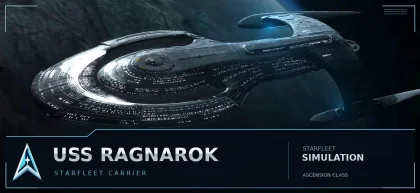
Raiders began striking civilian transports inside Romulan and Klingon space. The Romulans blamed the Klingons, who had been crossing into Romulan space on raids of their own for some time. The Klingons blamed the Romulans. Both demanded that the Federation act. The carrier USS Ragnarok was sent to patrol inside Federation space, to protect every freighter whatever its origin, and to disable rather than destroy any Romulan or Klingon craft it met.
Talks were held aboard. The Romulan Ambassador, V’rel, charged the Klingons with undermining the Empire’s efforts to rebuild its border settlements. The Klingon representative, General T’Sok, was by Federation accounts a good diplomat, for a Klingon. He accused the Federation of violating Klingon borders with sensor sweeps and said that the Klingon Empire could protect its own borders. He left saying that the Federation had no honour. The talks settled nothing between the two empires. The raiders proved to be a pirate band working from Ad Pontes, a planet about five light years inside Romulan space, directly across the border from Khitomer. The Empire had declared it uninhabited, and Klingon raids had always passed it by. See The USS Ragnarok and the Romulans for the full account.
The crisis showed the pattern that still holds. Each empire assumed the worst of the other, neither would share what it knew, and each expected the Federation to restrain the other side while being restrained itself in nothing.
10. How Each Sees the Other in 2393
10.1 The Klingon view
To a Klingon, the Romulan is everything a warrior should not be. He hides behind a cloak, strikes without declaring himself, lies as a matter of course and fights through others when he can. Narendra III, Khitomer and the House of Duras are not history to the Klingons; they are debts. Klingons respect Romulan ships and fear nothing about them, and they do not trust a Romulan word on any subject.
Klingon opinion is not all of one kind. Captains of the border houses, and the House of Vreth among the great houses, would like a harder line with the Romulans and say so on the Council. Others, among them the House of Tarkesh, whose ships and mines depend on quiet space, want the alliance with the Federation kept steady and see little gain in a war the Federation would not join. Neither side likes the Romulans.
10.2 The Romulan view
Romulans see Klingons as enemies, loud and violent, and the hatred is returned in full. To a Romulan, the Klingon is a brute who calls his appetite honour and his raiding courage. The raids of the 2380s are the freshest proof: the Klingons struck when the Empire was weakest, and called it vengeance.
The Romulans also take the Klingons seriously. The Nevrha Sector, where the Zone runs nearest to Klingon space, is held with Klingon ships as much in mind as Federation ones, and its garrisons look two ways. Klingon memory of Narendra III keeps them busy. See The Romulan Side of the Zone.
| Klingon grievances against the Romulans | Romulan grievances against the Klingons |
|---|---|
| Narendra III, 2344 | Raids on border holdings during the Silence and after |
| Khitomer, 2346, and the traitor | The charge of undermining the rebuilding of border settlements |
| Romulan aid to the House of Duras, 2367 to 2368 | The Klingon alliance with the Federation itself |
| The Krios plot, 2367 | Klingon contempt, and Klingon readiness to cross the line |
11. Provocations Aimed at the Klingons
On the stretches of the Zone that run close to Klingon space, Starfleet analysts believe that some Romulan provocations are aimed as much at the Klingons as at the Federation. A warbird that sits on its own side of the line for a week, a buoy that drifts, a signal that may be a trap: a Starfleet crew will watch it and log it, but a Klingon crew may answer it in a very different way, and the Romulans know it.
The analysts’ reasoning is simple. If a Klingon captain answers a provocation with force, the Federation must either restrain its own ally or share the blame for what the ally does. Either outcome serves the Romulans. A Federation that restrains the Klingons strains the alliance; a Federation that does not is answerable for a Klingon act in the Zone. The Empire has tried to divide the two allies before, at Khitomer in 2293, at Krios and through the House of Duras, and Starfleet sees no reason to think it has stopped. This is an assessment, not a proven fact. No Romulan provocation on the Zone has been shown beyond doubt to have been staged for Klingon eyes.
Klingon captains near the Zone share the Federation’s adversary but not its methods. Starfleet’s working rule on this border is that managing the Klingons is part of managing the Romulans. See The Klingon Frontier in 2393 for what this means in practice.
12. See Also
The Klingon Empire · History of the Klingon Empire · The Klingon Frontier in 2393 · The Great Houses · The Alliance with the Federation · The High Council and the Chancellor · The Romulan Side of the Zone · History of the Romulan Star Empire · The USS Ragnarok and the Romulans · The Neutral Zone (2393)
Last updated 4 days ago by